How Much Does It Cost to Go Skydiving in Texas?
Short answer: a standard tandem skydive in Texas typically runs $200–$350 per person, and specialty experiences — beach landings, proposal jumps, VIP packages — commonly run $400–$700+ nationally, since they include more than a standard jump ticket.
Here's the fuller breakdown — real numbers, not a vague national average — plus where a Gulf Coast jump fits into both ranges.
What tandem skydiving costs across Texas
Texas has more dropzones than most states — Austin, San Antonio, Dallas–Fort Worth, Houston, and the Gulf Coast all have active operations — and pricing is fairly consistent across them once you know what to look for:
| What you're booking | Typical price |
|---|---|
| Weekday tandem | $200–$260 |
| Weekend tandem | $230–$350 |
| Photo and/or video add-on | $100–$230 |
| Higher-altitude / premium jump tiers | $300–$350+ |
| Specialty packages (beach landings, proposals, VIP/ultimate experiences) | $400–$700+ |
Weekday jumps are almost always cheaper than weekends across the state — it's standard practice, not a markup. Altitude matters too: some operators sell tiered jumps, and the higher tiers cost more because there's simply more freefall time.
That specialty-package range isn't a Gulf Coast markup — it holds up across the country:
- Skydive the Gulf charges $500/person for its beach-landing jump on the Alabama coast.
- iSkydive Dallas prices its marriage-proposal jump at $499/person.
- Texas Skydiving in Austin prices its proposal package at $716.
- Skydive East Texas charges $410 for a tandem with full photo and video.
- Industry-wide, premium tandem experiences run $350–$500 even before adding a beach landing or a proposal setup on top.
A jump that adds a genuinely different experience — not just a slightly higher exit altitude — costs more everywhere, and that's exactly the category a beach landing falls into.
What actually drives the price
- Day of the week. Weekdays are quieter for every operator, so most pass the savings along. Expect to save $20–$40 by jumping Monday–Thursday.
- Altitude. More altitude means more freefall time, and pricing usually scales with it. A "full altitude" jump — over two miles up — costs more than a shorter, lower-altitude jump.
- Photo and video. Almost no dropzone includes this by default — it's a $100–$230 add-on nearly everywhere, since you can't bring your own camera on the jump.
- Location and experience. This is where dropzones actually differentiate. An inland dropzone over farmland and a coastal dropzone over the Gulf can charge similar base prices for a very different view.
Where the Gulf Coast fits in
At Skydive South Texas, on Mustang Island in Port Aransas, pricing spans both ends of the statewide range — a standard tandem priced right at the typical Texas rate, and two specialty jumps priced right in line with what beach landings and premium experiences cost anywhere else in the country:
| Package | Price | What's included |
|---|---|---|
| Classic Tandem | $259 weekday $279 weekend | Over two miles of freefall, USPA-certified instructor, training, gear |
| Beach Landing | $499 | Everything above, plus you land right on the sand on Mustang Island. Photo & video included (a $119 value). |
| Sunset Beach Landing | $599 | Everything in Beach Landing, under a golden-hour sky. Photo & video included (a $119 value). |
On the Classic Tandem, photo and video isn't automatically included — add photo + video for $119, or video only for $99. Both are included free on Beach and Sunset Beach Landings — a $119 value. We don't sell a photos-only tier; it's one bundled add-on, priced simply.
The Classic Tandem lands at a typical Texas weekday/weekend rate — no premium for the Gulf Coast view. The Beach Landing and Sunset Beach Landing cost more for the same reason specialty jumps cost more everywhere: you're not just buying a jump ticket, you're buying an actual beach touchdown plus $119 of photo and video bundled in at no extra charge.
Strip out that bundled media and the real price difference between a Classic Tandem and a Beach Landing is closer to $120 for a genuinely different landing — not a $240 markup. Compared to what other coastal and specialty operators charge for a similar experience, $499 and $599 land comfortably inside the market, not above it.
Why the Gulf Coast costs what it costs
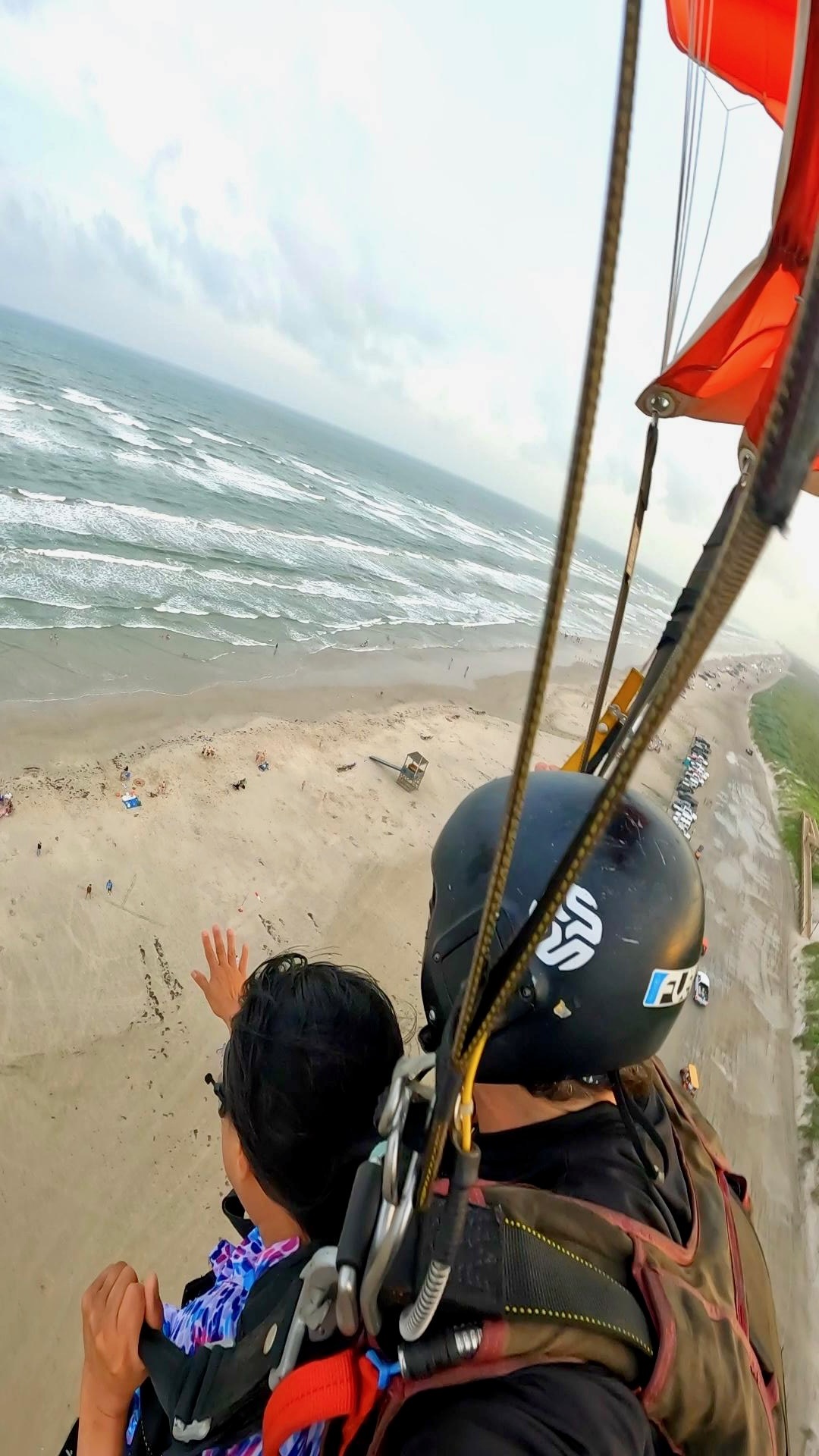
An inland jump gets you the freefall and a patchwork view of farmland. A coastal jump over Mustang Island gets you the Gulf, the barrier islands, and the surf line the entire way down — plus, on select days, the option to land on actual sand instead of a field.
That's not a price gimmick; it's a genuinely different jump, and it's why people regularly drive in from Austin, San Antonio, and Houston specifically for it rather than jumping closer to home. If you're weighing that drive, we wrote the honest case for making it.
Before you book
A couple of quick things that affect what you'll pay, but aren't really pricing questions on their own:
- Deposit: $100 holds your slot, applied toward your total — it carries over to a new date if weather pushes your jump.
- Tipping: not required anywhere in Texas, but most jumpers tip $20–$50 for the experience.
Age requirements, weight limits, and our full weather-rescheduling policy work the same way at every price tier — see the complete details on our FAQ page.
What about AFF and solo licensing?
Some Texas dropzones run full Accelerated Freefall (AFF) programs toward a solo license — that's a real path that can run into the thousands of dollars across multiple jump levels. Skydive South Texas is a tandem, Beach Landing, and scenic-flight operation, so we don't teach AFF in-house. If solo licensing is the goal, give us a call and we'll connect you with partner dropzones who do.
The bottom line
Across Texas, expect to budget $200–$350 for a standard tandem skydive, and $400–$700+ if you're after a specialty experience like a beach landing.
At Skydive South Texas, a standard jump starts at $259 on a weekday — right at the low end of the statewide range — and a Sunset Beach Landing with photo and video included runs $599, which lines up with what beach-landing and premium packages cost at dropzones nationwide, not above it. You're not paying more to jump here; you're paying for a materially different jump when you choose one, with the media bundled in either way.
Keep exploring
- Wondering if the drive from Austin or San Antonio is worth it? Here's the honest answer.
- Curious what a beach landing actually involves? See how it works.
- Building a Port A trip around your jump? Here's what else to do while you're here.
Ready to book? See all packages and book online, or check our FAQ if you've got questions first.